Introduction
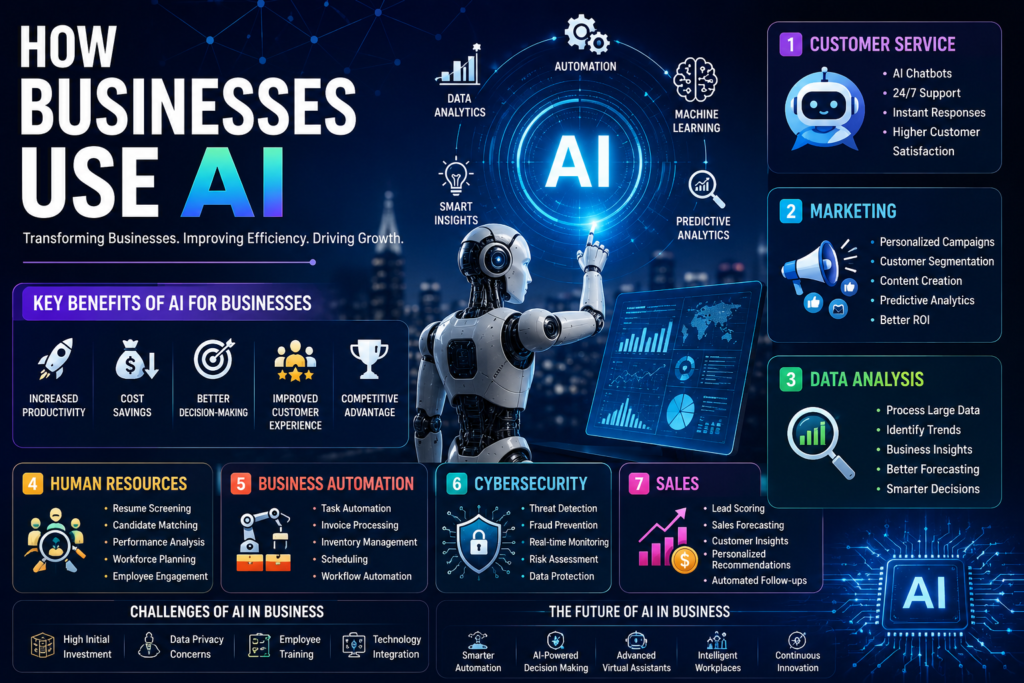
Artificial Intelligence (AI) is revolutionizing the business world by helping companies improve efficiency, reduce costs, and make smarter decisions. In 2026, businesses of all sizes are using AI-powered tools and technologies to automate tasks, analyze data, enhance customer experiences, and drive innovation. According to Tech Gadget, AI has become a critical part of modern business operations.
From small startups to multinational corporations, AI has become a critical part of modern business operations. Companies are using AI to streamline workflows, improve productivity, and gain a competitive advantage in rapidly changing markets. As AI technology continues to evolve, its impact on businesses is becoming more significant than ever before.
This article explores how businesses use AI, the benefits it offers, and the future of Artificial Intelligence in the corporate world.
What is Artificial Intelligence in Business?
Artificial Intelligence in business refers to the use of intelligent software and machine learning technologies to automate processes, analyze information, and support decision-making. AI systems can process large amounts of data, identify patterns, and provide valuable insights that help organizations operate more effectively.
Unlike traditional software, AI can learn from experience and improve its performance over time. This ability makes AI a powerful tool for businesses seeking greater efficiency and innovation.
Why Businesses Use AI
Businesses use AI because it helps them solve complex problems, improve customer satisfaction, and reduce operational costs.
Some of the main reasons companies adopt AI include:
- Increased productivity
- Better decision-making
- Faster customer support
- Improved marketing performance
- Reduced operating costs
- Enhanced security
- Business automation
AI enables organizations to focus on strategic growth while automating repetitive and time-consuming tasks.
AI in Customer Service
One of the most common uses of AI in business is customer service. AI-powered chatbots and virtual assistants can answer customer questions, provide support, and resolve issues 24 hours a day.
Benefits of AI Customer Service
- Instant responses
- Reduced waiting times
- Lower support costs
- Improved customer satisfaction
- Round-the-clock availability
Many businesses use AI chatbots on websites, mobile applications, and social media platforms to enhance customer experiences.
AI in Marketing
Marketing departments use AI to create personalized campaigns, analyze customer behavior, and improve advertising performance.
How AI Helps Marketing
- Customer segmentation
- Content creation
- Email marketing automation
- Social media management
- Predictive analytics
AI-powered marketing tools help businesses understand their audience and deliver more relevant content.
AI in Data Analysis
Businesses generate massive amounts of data every day. AI helps organizations analyze this information quickly and accurately.
AI can identify trends, predict future outcomes, and provide insights that support business growth.
Advantages of AI Data Analysis
- Faster reporting
- Improved accuracy
- Better forecasting
- Smarter decision-making
- Real-time business insights
Companies use AI analytics to improve operations, increase sales, and identify new opportunities.
AI in Human Resources
Human Resource departments are increasingly using AI to improve recruitment and employee management.
AI Applications in HR
- Resume screening
- Candidate matching
- Employee performance analysis
- Workforce planning
- Employee engagement monitoring
AI helps HR professionals save time and make more informed hiring decisions.
AI in Business Automation
Automation is one of the biggest advantages of Artificial Intelligence. Businesses use AI to automate repetitive tasks, reducing manual work and allowing employees to focus on higher-value activities.
Commonly Automated Tasks
- Data entry
- Invoice processing
- Inventory management
- Appointment scheduling
- Customer communications
AI in Cybersecurity
Cybersecurity threats continue to increase, making AI an important tool for protecting business systems and data.
How AI Improves Security
- Threat detection
- Fraud prevention
- Network monitoring
- Risk assessment
- Real-time security alerts
AI-powered security systems can identify suspicious activity and respond faster than traditional security methods.
AI in Sales
Sales teams use AI to improve lead generation, customer engagement, and revenue growth. AI helps businesses identify potential customers and improve conversion rates.
AI Sales Benefits
- Lead scoring
- Customer insights
- Sales forecasting
- Personalized recommendations
- Automated follow-ups
Benefits of AI for Businesses
The advantages of AI extend across nearly every business function, offering significant improvements in how organizations operate.
Increased Productivity
AI automates repetitive tasks, allowing employees to focus on more important responsibilities and higher-value activities.
Cost Savings
Businesses can reduce operational expenses through automation, improved efficiency, and optimized resource allocation.
Better Decision-Making
AI provides data-driven insights and predictive analytics that support strategic business decisions and long-term planning.
Improved Customer Experience
Personalized interactions and faster response times help businesses build stronger customer relationships and improve brand loyalty.
Competitive Advantage
Organizations that adopt AI often outperform competitors by operating more efficiently and innovating faster.
Challenges of AI in Business
Although AI offers many benefits, businesses also face challenges when implementing AI solutions.
High Initial Investment
AI technologies and infrastructure may require significant financial resources and ongoing investment.
Data Privacy Concerns
Businesses must ensure customer data remains secure and protected while complying with data privacy regulations.
Employee Training
Workers may need specialized training to effectively use AI-powered systems and adapt to new workflows.
Technology Integration
Integrating AI with existing business systems and legacy software can sometimes be complex and time-consuming.
Future of AI in Business
The future of AI in business looks extremely promising. As technology advances, companies will increasingly rely on intelligent systems to improve productivity and innovation. Businesses that embrace AI early will be better positioned for long-term success.
Future Developments
- Advanced AI assistants
- Fully automated business processes
- Smarter customer experiences
- AI-powered decision-making
- Predictive business intelligence
- Intelligent workplace automation
Frequently Asked Questions
How do businesses use AI?
Businesses use AI for customer service, marketing, data analysis, cybersecurity, sales, human resources, and business automation.
Why is AI important for businesses?
AI improves efficiency, reduces costs, enhances customer experiences, and supports better decision-making.
Can small businesses use AI?
Yes, many affordable AI tools are available for small businesses, including chatbots, marketing software, and automation platforms.
What industries use AI the most?
Industries such as healthcare, finance, retail, manufacturing, technology, and logistics heavily rely on AI solutions.
Conclusion
Artificial Intelligence is transforming the way businesses operate in 2026. From customer service and marketing to cybersecurity and automation, AI helps organizations improve productivity, reduce costs, and make smarter decisions. As technology continues to evolve, businesses that adopt AI will gain a significant competitive advantage and be better prepared for the future digital economy.
For more insights on the latest technology, visit Tech Gadget.