Introduction
Pluto is one of the most famous and mysterious worlds in our Solar System. Once considered the ninth planet, Pluto was officially reclassified as a dwarf planet by the International Astronomical Union (IAU) in 2006. Although it no longer holds the title of a major planet, Pluto remains one of the most fascinating objects beyond Neptune. Its icy mountains, frozen plains, thin atmosphere, and surprisingly active geology have transformed scientists’ understanding of distant worlds, according to Tech Gadget.
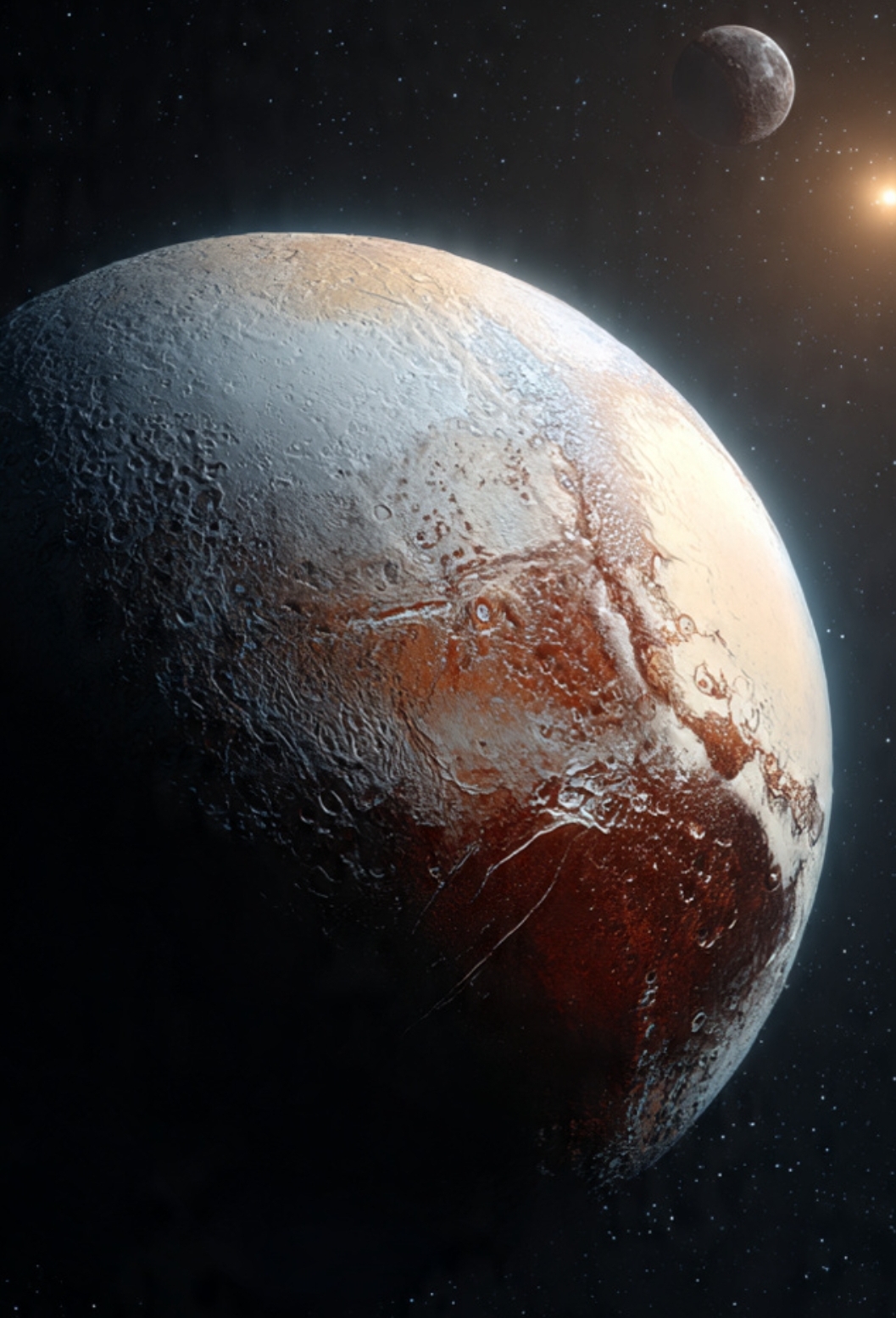
Located in the Kuiper Belt, a vast region filled with icy objects beyond Neptune, Pluto is incredibly cold and receives only a tiny fraction of the sunlight that reaches Earth. Despite its great distance from the Sun, Pluto has become one of the most important destinations in planetary science thanks to NASA’s historic New Horizons mission, which revealed a surprisingly complex and beautiful world.
The Heart of Pluto: Tombaugh Regio
One of the most stunning discoveries made by the New Horizons spacecraft in 2015 was a massive, heart-shaped glacier named Tombaugh Regio. This “heart” is primarily composed of nitrogen ice and spans about 1,590 kilometers. The left lobe of the heart, known as Sputnik Planitia, is a smooth plain that appears to be geologically young, suggesting that Pluto is far more active than scientists previously imagined.
Beneath this icy surface, some scientists believe there could be a subsurface ocean of liquid water. If true, this would mean that even at the cold, dark edges of our Solar System, the conditions for liquid water—and potentially life—might exist.
Pluto’s Complex Atmosphere and Moons
Pluto has a surprisingly complex atmosphere made of nitrogen, methane, and carbon monoxide. When Pluto moves farther away from the Sun in its elliptical orbit, its atmosphere can actually freeze and fall to the surface as snow. When it gets closer to the Sun, the ice sublimates back into gas, creating a thin blue haze that was captured in beautiful detail by NASA.
Pluto also has five known moons: Charon, Styx, Nix, Kerberos, and Hydra. Charon is the largest, being nearly half the size of Pluto itself. Because they are so close in size, Pluto and Charon are often referred to as a double dwarf planet system, as they orbit around a common center of mass located outside of Pluto.
Basic Facts About Pluto
| Feature | Information |
|---|---|
| Classification | Dwarf Planet |
| Discovery Date | February 18, 1930 |
| Discoverer | Clyde Tombaugh |
| Average Distance from Sun | 5.9 billion km |
| Diameter | 2,377 km |
| Radius | 1,188 km |
| Length of One Day | About 6.4 Earth Days |
| Length of One Year | About 248 Earth Years |
| Average Surface Temperature | -229°C |
| Surface Gravity | 0.62 m/s² |
| Number of Moons | 5 |
| Rings | None |
Geology: Mountains of Water Ice
Pluto’s surface is home to towering mountains that reach heights of up to 3,500 meters (11,000 feet). Interestingly, these mountains are not made of rock, but of frozen water ice. At the extreme temperatures on Pluto, water ice becomes as hard as rock, allowing it to form massive peaks. These mountains sit on top of softer ices like nitrogen and methane, creating a unique and rugged landscape.
Why is Pluto no longer a Planet?
In 2006, the IAU defined a planet as a celestial body that: (1) orbits the Sun, (2) has sufficient mass for a nearly round shape, and (3) has cleared the neighborhood around its orbit. Pluto fails the third criteria because it shares its orbital path with many other objects in the Kuiper Belt. This led to its reclassification as a dwarf planet, a decision that remains a topic of debate among space enthusiasts today.
Conclusion
Pluto continues to challenge our understanding of the outer Solar System. From its heart-shaped glaciers to its complex system of moons, it remains a primary interest for astronomers and space enthusiasts alike. As we continue to analyze data from missions like New Horizons, Tech Gadget will keep you updated on the latest discoveries from this distant icy world.