Introduction
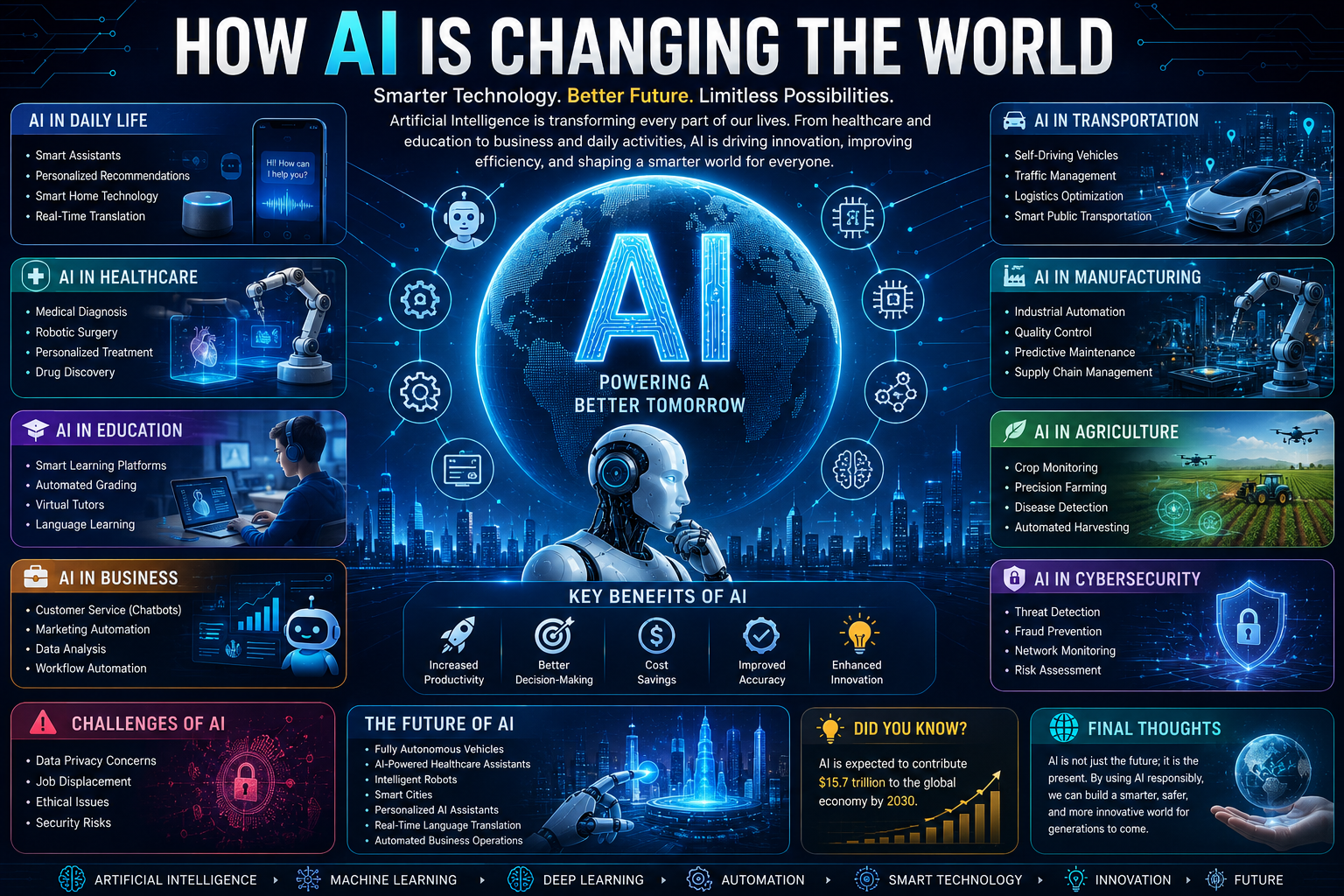
Artificial Intelligence (AI) is one of the most revolutionary technologies of the 21st century. Over the past decade, AI has transformed industries, improved productivity, and changed the way people live and work. Today, AI is no longer limited to science fiction or advanced research labs. It has become an essential part of daily life, powering everything from smartphones and virtual assistants to healthcare systems and self-driving vehicles. At Tech Gadget, we explore how these innovations are shaping our world.
As AI technology continues to evolve, its influence on society grows stronger. Businesses use AI to automate operations, healthcare professionals rely on AI for diagnosis and treatment, and educators use intelligent systems to personalize learning experiences. AI is helping solve complex problems while creating new opportunities for innovation and growth.
This article explores how AI is changing the world, its major applications, benefits, challenges, and what the future may hold for Artificial Intelligence.
What is Artificial Intelligence?
Artificial Intelligence refers to computer systems that can perform tasks requiring human intelligence. These tasks include learning, reasoning, problem-solving, decision-making, language understanding, and visual recognition.
AI technologies use machine learning, deep learning, natural language processing, and computer vision to analyze information and improve performance over time. Unlike traditional software, AI systems can learn from data and adapt to changing environments.
Today, AI powers many of the technologies people use every day, making life more efficient and convenient.
How AI is Transforming Daily Life
One of the biggest ways AI is changing the world is through its impact on daily life.
Smart Assistants
Virtual assistants such as AI-powered chatbots and voice assistants help people manage schedules, answer questions, set reminders, and control smart devices.
Personalized Recommendations
Streaming platforms, online stores, and social media networks use AI to recommend content, products, and services based on user preferences.
Smart Home Technology
AI-powered smart homes allow users to control lighting, security systems, appliances, and climate settings through intelligent automation.
Real-Time Translation
Advanced AI systems provide instant language translation, making communication easier between people from different countries and cultures.
These technologies improve convenience and save time in everyday activities.
AI in Healthcare
Healthcare is one of the industries experiencing the greatest transformation through AI.
Medical Diagnosis
AI can analyze medical images and patient data to detect diseases earlier and more accurately.
Robotic Surgery
AI-powered surgical robots help doctors perform complex procedures with greater precision and reduced risks.
Personalized Treatment
AI analyzes patient information to recommend customized treatment plans based on individual needs.
Drug Discovery
Pharmaceutical companies use AI to accelerate research and identify potential new medications.
These innovations improve patient outcomes and make healthcare more efficient.
AI in Education
Artificial Intelligence is transforming education by creating more personalized learning experiences.
Smart Learning Platforms
AI-powered educational systems adapt to students’ learning styles and progress levels.
Automated Grading
Teachers use AI tools to grade assignments and tests more efficiently.
Virtual Tutors
AI tutors provide students with additional support and personalized guidance outside the classroom.
Language Learning
AI-powered language apps help users improve vocabulary, pronunciation, and communication skills.
As technology advances, AI will continue to improve access to quality education worldwide.
AI in Business
Businesses across the globe are using AI to improve efficiency and increase profitability.
Customer Service
AI chatbots provide instant customer support and resolve common issues without human intervention.
Marketing Automation
Companies use AI to analyze customer behavior and create personalized marketing campaigns.
Data Analysis
AI processes large volumes of data and provides valuable business insights.
Workflow Automation
Businesses automate repetitive tasks such as scheduling, invoicing, and inventory management.
AI helps organizations reduce costs, increase productivity, and improve decision-making.
AI in Transportation
Transportation is becoming smarter and safer thanks to Artificial Intelligence.
Self-Driving Vehicles
AI-powered autonomous vehicles use sensors and machine learning algorithms to navigate roads safely.
Traffic Management
Cities use AI systems to monitor traffic flow and reduce congestion.
Logistics Optimization
Delivery companies use AI to improve route planning and increase operational efficiency.
Public Transportation
AI helps transportation systems provide better services through predictive maintenance and real-time monitoring.
These advancements contribute to safer and more efficient transportation networks.
AI in Manufacturing
Manufacturing industries are adopting AI to create smarter and more efficient production systems.
Industrial Automation
AI-powered robots perform repetitive tasks with speed and precision.
Quality Control
Computer vision systems inspect products and detect defects automatically.
Predictive Maintenance
AI identifies equipment issues before failures occur, reducing downtime.
Supply Chain Management
Manufacturers use AI to optimize inventory levels and improve logistics operations.
Smart factories powered by AI are becoming increasingly common around the world.
AI in Agriculture
Agriculture is another sector benefiting significantly from Artificial Intelligence.
Crop Monitoring
AI analyzes data from drones and sensors to monitor crop health.
Precision Farming
Farmers use AI to optimize irrigation, fertilization, and planting schedules.
Disease Detection
AI systems identify plant diseases early, reducing crop losses.
Automated Harvesting
Robotic systems assist with harvesting and improve agricultural productivity.
These technologies help meet growing food demands while reducing waste.
AI in Cybersecurity
As cyber threats continue to evolve, AI plays an important role in protecting digital systems.
Threat Detection
AI identifies unusual activities and potential security breaches.
Network Monitoring
AI continuously monitors networks and responds to threats in real time.
Risk Assessment
Organizations use AI to identify vulnerabilities and strengthen security measures.
AI-powered cybersecurity solutions help businesses and individuals stay protected.
Benefits of Artificial Intelligence
AI offers numerous advantages across industries and society.
Increased Productivity
Automation allows people and organizations to complete tasks more efficiently.
Better Decision-Making
AI analyzes large datasets and provides accurate insights.
Cost Savings
Businesses reduce operational expenses through automation.
Improved Accuracy
AI minimizes human errors in many processes.
Enhanced Innovation
Artificial Intelligence enables the development of new products, services, and solutions.
These benefits make AI one of the most valuable technologies in the modern world.
Challenges of AI
Despite its advantages, AI also presents several challenges.
Data Privacy Concerns
Many AI systems require large amounts of personal data.
Security Risks
Advanced AI technologies may be vulnerable to misuse or cyberattacks.
Addressing these challenges is essential for responsible AI development.
The Future of AI
The future of Artificial Intelligence is incredibly promising. Researchers and technology companies continue to develop more advanced AI systems capable of solving complex problems.
Future innovations may include:
- Fully autonomous vehicles
- Advanced healthcare assistants
- Intelligent robots
- AI-powered smart cities
- Personalized digital assistants
- Real-time language translation systems
- Automated business operations
As AI continues to evolve, it will play an even greater role in shaping the future of society.
Frequently Asked Questions
What is Artificial Intelligence?
Artificial Intelligence is technology that enables machines to perform tasks that typically require human intelligence.
How is AI changing the world?
AI is transforming industries such as healthcare, education, transportation, business, agriculture, and cybersecurity through automation and intelligent decision-making.
What are the benefits of AI?
AI improves productivity, accuracy, efficiency, innovation, and decision-making.
Will AI replace humans?
AI is designed to assist humans and automate repetitive tasks. While some jobs may change, new opportunities will also emerge.
Conclusion
Artificial Intelligence is changing the world in remarkable ways. From healthcare and education to transportation and business, AI is helping solve problems, improve efficiency, and create new opportunities for growth. As technology continues to advance, AI will become even more integrated into everyday life, transforming industries and shaping the future of humanity. For more insights into technology, stay tuned to Tech Gadget. Organizations and individuals that embrace AI today will be better prepared for the opportunities and challenges of tomorrow.